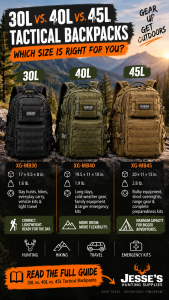
30L vs. 40L vs. 45L Tactical Backpacks: Which Size Do You Need?
Choosing the right tactical backpack starts with one simple question: How much gear do you actually need to carry?
When comparing a 30L vs. 40L backpack, the difference may seem straightforward. But once you add clothing, food, water, hunting equipment and emergency supplies, those extra liters can make a significant difference. For larger loads, you may be deciding between a 30L vs. 45L backpack or a 40L vs. 45L backpack.
At Jesse’s Hunting Supplies, we offer tactical backpacks in all three sizes to help you match your pack to the way you hunt, hike, travel and prepare.
In this guide, we'll compare the XGear Tactical XG-MB30, XG-MB40 and XG-MB45 backpacks and explain which size may be the best fit for your needs.
Quick Takeaways
30L is ideal for day hunts, day hikes, everyday carry and lighter loads.
40L provides additional room for clothing, food, emergency equipment and longer days in the field.
45L offers the most capacity of the three and is well suited for bulky gear and short overnight trips.
Backpack capacity isn't the only factor. Dimensions, empty weight, organization, compression straps and fit all matter.
Bigger isn't always better. The best backpack is the smallest pack that comfortably carries everything you actually need.
Tactical Backpack Size Comparison
| Backpack | Model | Dimensions | Empty Weight | Best For |
|---|---|---|---|---|
| 30L | XG-MB30 | 17 × 9.5 × 8 in. | 1.6 lb. | Day hunts, hikes, EDC, vehicle kits and light travel |
| 40L | XG-MB40 | 19.5 × 11 × 10 in. | 1.9 lb. | Long days, cold-weather gear, family equipment and larger emergency kits |
| 45L | XG-MB45 | 20 × 11 × 13 in. | 2.8 lb. | Bulky equipment, short overnights, range gear and larger preparedness kits |
These are nominal capacities. Two backpacks with the same listed capacity can feel very different depending on how their compartments, pockets and internal organization are designed.
What Does Backpack Capacity in Liters Mean?
A backpack's capacity, measured in liters, is an estimate of the total amount of space available inside the pack.
Moving from a 30L to a 40L backpack gives you approximately 10 additional liters of storage. Going from 40L to 45L adds another five liters.
That extra space can make room for things such as:
An extra jacket or insulating layer
Rain gear
Additional food
Water and water-treatment supplies
First-aid equipment
Navigation equipment
Emergency supplies
Larger or bulkier hunting gear
It's important to remember that capacity doesn't determine how much weight a backpack can safely or comfortably carry.
A backpack filled with clothing weighs considerably less than one packed with dense equipment and water. Your fitness level, terrain, trip length and the backpack's support system should all be considered when determining your ideal load.
For most day-use activities, a 30L pack can provide plenty of room. If your equipment becomes more substantial, stepping up to 40L or 45L gives you additional flexibility.
30L Tactical Backpack: When Smaller Is Better
A 30 liter tactical backpack is the compact option of the three. If you're primarily heading out for a day hunt, scouting trip, hike or everyday task, the smaller footprint can be a major advantage.
The XGear Tactical XG-MB30 30L backpack measures 17 × 9.5 × 8 inches and weighs just 1.6 pounds empty.
View the XGear Tactical XG-MB30 30L Backpack
The XG-MB30 features 600D Oxford material, a zip-around main compartment, internal zip and mesh pockets, a divider for a laptop or tablet, padded adjustable shoulder straps, a breathable mesh back and side compression straps.
It also features MOLLE webbing and accessory loops for compatible attachments, along with a small sleeve designed to accommodate a hydration bladder. The hydration bladder is not included.
Choose the 30L pack if you:
Hunt during the day and return before dark
Go on day hikes or scouting trips
Prefer a smaller, lighter backpack
Need a compact vehicle emergency kit
Carry everyday work or range essentials
Pack efficiently and don't need much bulky clothing
The downside of going smaller
The primary limitation of a 30L pack is available space.
If you regularly carry heavy winter clothing, larger optics, additional food or equipment for another person, a 30L backpack can fill up quickly.
If you're constantly attaching gear to the outside of your pack simply because there's no room inside, that may be a sign that it's time to move up to 40L.
40L Tactical Backpack: The Versatile Middle Ground
For many hunters and outdoor enthusiasts, 40L may be the sweet spot.
A 40L tactical backpack provides noticeably more storage than a 30L model without making a dramatic jump in empty weight.
The XGear Tactical XG-MB40 40L backpack measures 19.5 × 11 × 10 inches and weighs 1.9 pounds empty.
View the XGear Tactical XG-MB40 40L Backpack
The XG-MB40 uses 800D Oxford material and features a spacious zip-around main compartment, internal organization, a laptop or tablet divider, padded adjustable shoulder straps, breathable mesh backing, side compression straps and MOLLE attachment points.
It also includes a small hydration-bladder sleeve.
The biggest advantage is flexibility. You have more room for additional equipment without immediately moving into the bulk of a larger pack.
Choose the 40L pack if you:
Spend long days hunting or scouting
Need additional clothing for changing weather
Hunt during colder seasons
Carry extra food or water
Carry equipment for a child or another person
Want a larger vehicle emergency bag
Need additional organization for travel
Regularly outgrow a 30L pack
30L vs. 40L: Is the Extra Space Worth It?
For many users, the answer is yes.
The XG-MB40 provides 10 additional liters of nominal capacity while increasing the empty weight by only 0.3 pound compared with the XG-MB30.
That makes the 40L model an attractive choice if you want additional capacity without making a major jump in backpack weight.
45L Tactical Backpack: Maximum Capacity
If your priority is having the most room possible among these three options, the 45L tactical backpack is the largest choice.
The additional capacity can be particularly useful when you're carrying bulky equipment, additional layers or supplies for a short overnight trip.
The XGear Tactical XG-MB45 45L backpack measures 20 × 11 × 13 inches and has a listed empty weight of 2.8 pounds.
View the XGear Tactical XG-MB45 45L Backpack
The XG-MB45 features multiple pockets and zippered compartments, MOLLE webbing, side and front compression, a ventilated back section, double stitching, heavy-duty zippers and utility-style zipper pulls.
Choose the 45L pack if you:
Carry bulky cold-weather hunting equipment
Need additional space for short overnight trips
Carry range or outdoor equipment that doesn't compress well
Want a larger emergency or preparedness kit
Frequently run out of space in a 30L or 40L pack
Prefer having extra room for changing conditions
Keep the extra size in mind
The 45L pack offers only five additional liters of nominal capacity compared with the 40L model.
However, the dimensions are different. The 45L model is 13 inches deep, compared with 10 inches for the XG-MB40.
It also weighs 2.8 pounds empty—0.9 pound more than the 40L model.
That's why we recommend choosing the 45L model because you need the additional space, rather than simply choosing it because it's the largest backpack.
30L vs. 40L Backpack: Which One Should You Choose?
For most day hunts and day hikes, a 30L backpack is enough when you pack efficiently.
A smaller pack keeps your load relatively compact and can be easier to maneuver through brush, get in and out of a vehicle with and store when you're not using it.
However, the 40L model becomes more attractive when your normal load includes:
Insulated clothing
Rain gear
Extra food
Additional water
Larger optics
Emergency equipment
Gear for another person
If you're constantly struggling to fit everything into your 30L pack, moving to a 40L backpack can make your outings much easier.
Our general recommendation: Choose 30L for compact day use and 40L when you want additional flexibility.
30L vs. 45L Backpack: Do You Need the Extra Space?
The jump from 30L to 45L is significant.
You're gaining approximately 15 liters of nominal capacity, but you're also moving into a larger physical pack.
A 30L backpack makes sense when mobility and compactness are priorities. A 45L pack makes more sense when you're carrying equipment that simply takes up more room.
Think about your typical gear rather than the number printed on the backpack.
If your load consists primarily of compact essentials, a 30L pack may be all you need.
If you're carrying winter clothing, food, emergency supplies, shelter or other bulky equipment, the 45L model gives you considerably more flexibility.
40L vs. 45L Backpack: Is Five More Liters Worth It?
This is perhaps the closest decision of the three.
The difference between 40L and 45L doesn't sound significant, but the shape and dimensions of the backpack matter just as much as the capacity number.
The XG-MB45 is three inches deeper than the XG-MB40. That additional depth can make it easier to pack bulky equipment.
The tradeoff is weight.
The XG-MB45 weighs 2.8 pounds empty compared with 1.9 pounds for the XG-MB40.
Choose 40L when:
You want a versatile everyday outdoor pack
Most of your equipment is relatively compact
You want to keep empty weight down
You primarily take day trips
You occasionally need additional capacity
Choose 45L when:
You frequently carry bulky equipment
You need room for overnight gear
You're building a more comprehensive emergency kit
Your 40L pack regularly feels too small
You value additional packing flexibility
Don't Choose a Tactical Backpack by Capacity Alone
The number of liters is important, but it shouldn't be the only thing you consider.
Fit and Comfort
A backpack should sit securely and comfortably on your body. Adjustable shoulder straps allow you to customize the fit.
Whenever possible, evaluate comfort with a realistic load rather than judging a pack while it's empty.
Empty Weight
Remember that every pound of backpack weight is weight you'll carry before you add your gear.
A lightweight pack can be especially useful for day hunts and hikes. On the other hand, heavier construction and additional features may be worthwhile when you need a larger, more capable loadout.
Organization
Pockets and internal dividers make it easier to separate equipment and quickly find frequently used items.
However, too many small compartments can make it difficult to pack large or oddly shaped equipment.
Think about the gear you actually carry and choose an organization system that works for it.
MOLLE Attachment Points
MOLLE webbing allows you to attach compatible pouches and accessories to the outside of your backpack.
It's a useful feature for customizing your setup, but avoid adding unnecessary weight. Excessive equipment on the outside of the pack can also snag on brush and affect balance.
Compression Straps
Compression straps help keep your load stable when the backpack isn't completely full.
They're particularly useful if you want one pack to handle different types of trips and load sizes.
Weather Protection
The XG-MB30 and XG-MB40 are described as using waterproof Oxford material. However, fabric alone doesn't necessarily mean every zipper and seam is completely watertight.
If you're heading into sustained rain, consider using waterproof pouches or a pack liner to protect important equipment.
What Should You Carry in a Tactical Backpack?
The right gear depends on where you're going, how long you'll be gone and what conditions you may encounter.
For outdoor preparation, the National Park Service's Ten Essentials provide a useful framework:
Navigation
Sun protection
Extra clothing
Flashlight or headlamp
First-aid supplies
Fire-starting equipment where permitted
Repair tools
Extra food
Water and water-treatment supplies
Emergency shelter
Your actual loadout should be tailored to your activity and environment.
A day hunt in mild weather may require significantly less equipment than an all-day trip in cold, wet conditions.
The goal isn't to fill your backpack just because you have available space. The goal is to carry the equipment that can genuinely improve your preparedness, safety and comfort.
Frequently Asked Questions
Is a 30L Backpack Big Enough for Hunting?
Yes. A 30L backpack can be an excellent choice for a day hunt when your equipment is relatively compact and you don't need to carry large amounts of clothing or overnight equipment.
Before choosing your size, lay out your normal food, water, clothing, optics and safety equipment and see how much space they actually require.
Is a 40L Backpack Too Large for a Daypack?
No. A 40L backpack can work very well as a daypack, particularly during colder weather or when you're carrying additional equipment.
Compression straps can help stabilize the load when the backpack isn't completely full.
Is a 45L Backpack Suitable for an Overnight Trip?
A 45L backpack can be suitable for a short overnight trip if your shelter, sleeping equipment, clothing and food are relatively compact.
Your required capacity will depend heavily on weather, equipment size and how much water you need to carry.
Can a 45L Tactical Backpack Be Used as Airline Carry-On Luggage?
Possibly, but you should always check the airline's current carry-on requirements before traveling.
A backpack's liter rating doesn't determine whether an airline will accept it as carry-on luggage. Compare the actual packed exterior dimensions with your airline's current limits.
What Size Tactical Backpack Is Best for an Emergency Kit?
For a compact vehicle emergency kit, 30L may be sufficient.
If you're building a larger kit with additional food, water, clothing, first-aid supplies and emergency shelter, a 40L or 45L backpack provides more room.
Choose the size that lets you organize the equipment properly without creating an unnecessarily heavy load.
Is a Larger Tactical Backpack Always Better?
No.
A larger backpack weighs more, takes up more space and can encourage you to carry equipment you don't really need.
The best approach is to choose the smallest backpack that comfortably accommodates your essential gear while leaving some room for changing conditions.
So, Which Tactical Backpack Size Is Right for You?
There's no single answer for everyone.
The right size depends on what you're carrying, where you're going and how long you'll be out.
Choose the 30L XG-MB30 if you want:
A compact, lightweight pack for day hunts, hiking, scouting and everyday use.
Choose the 40L XG-MB40 if you want:
A versatile backpack with extra room for clothing, food, emergency gear and longer days in the field.
Choose the 45L XG-MB45 if you want:
Maximum capacity for bulky equipment, short overnight trips and larger preparedness loadouts.
The simplest rule is this:
Choose the smallest backpack that comfortably holds the gear you actually need.
A well-packed 30L backpack can be more useful than an overloaded 45L pack. But if you're constantly fighting for space, upgrading to 40L or 45L can make a big difference.
Find the Right Tactical Backpack at Jesse's Hunting Supplies
Whether you're preparing for your next hunt, heading out for a day on the trail or putting together an emergency gear kit, Jesse's Hunting Supplies has tactical backpack options to match different load sizes and uses.
Shop Tactical Backpacks at Jesse's Hunting Supplies
Start with the gear you need to carry. Then choose the backpack that gives you enough room to keep it organized and accessible—without carrying more pack than you need.